huh what's a covector
okok let's start w fruit :>
so say you need a couple fruit, and so you're walking to the fruit-buying-place of your choice w your list that says you need:
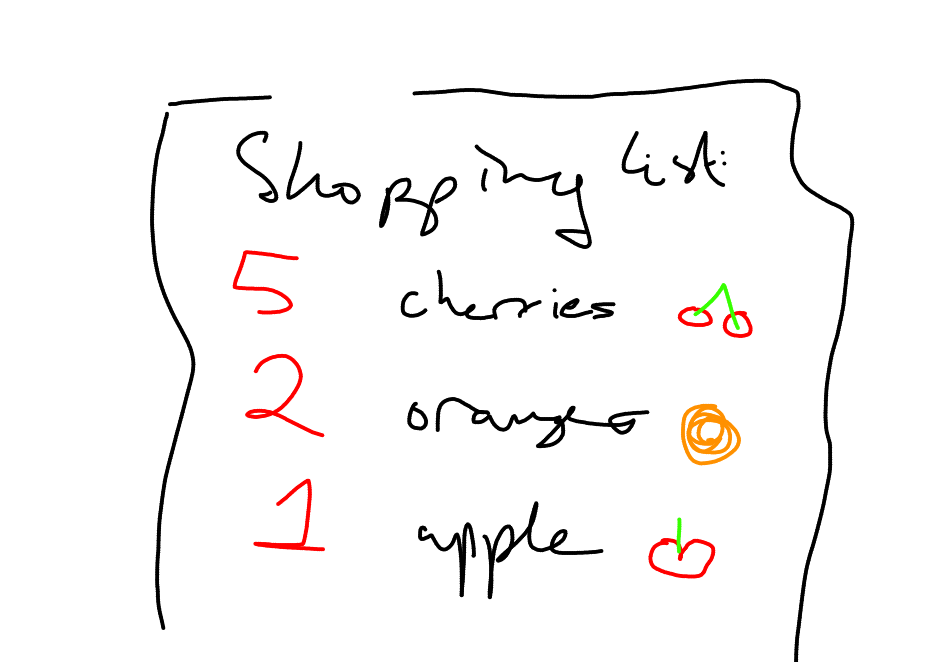 simple nuff :3
so you get to your plug and you notice that, oh coolio, the prices are right there!
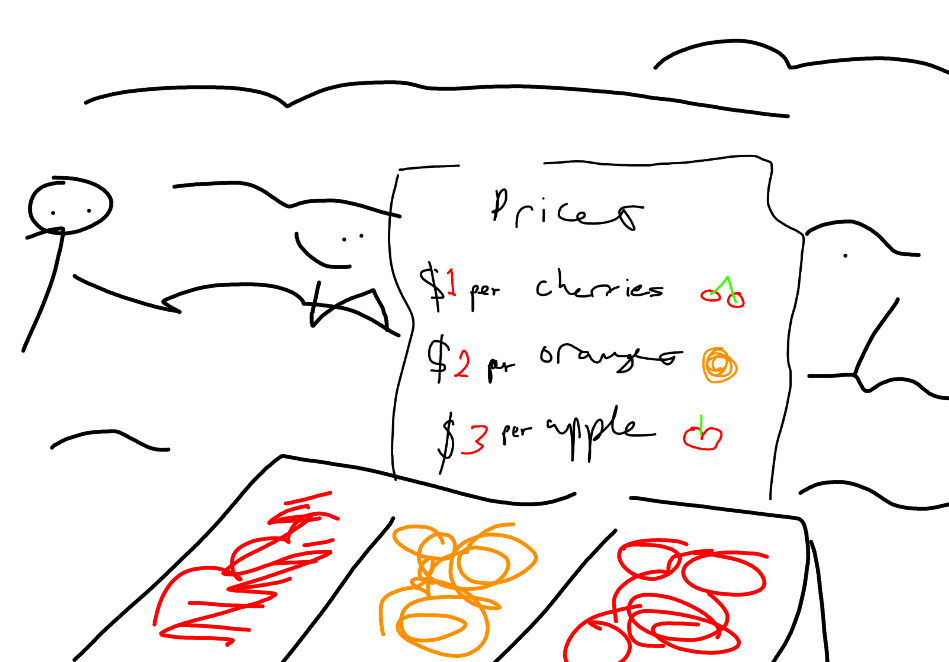
so, how much does all of your fruit cost? (you can do this one) (ignore tax)
but more importantly, how did you get your answer?
You multiply:
the price of the cherries with the number of cherries, = $1 * 5
the price of the oranges with the number of oranges, = $2 * 2
the price of the apples with the number of apples, = $3 * 1
And then you add them all up to get the total cost = $5 + $4 + $3 = $12. simple nuff!
The next day, you go with a different list of fruits to get, because you ate all of the previous days’ :<
There’s still the exact same fruit, but different amounts.
So you get some number of cherries (we’ll call that variable c)
Some number of oranges (we’ll call that variable o)
And some number of apples (we’ll call that variable a)
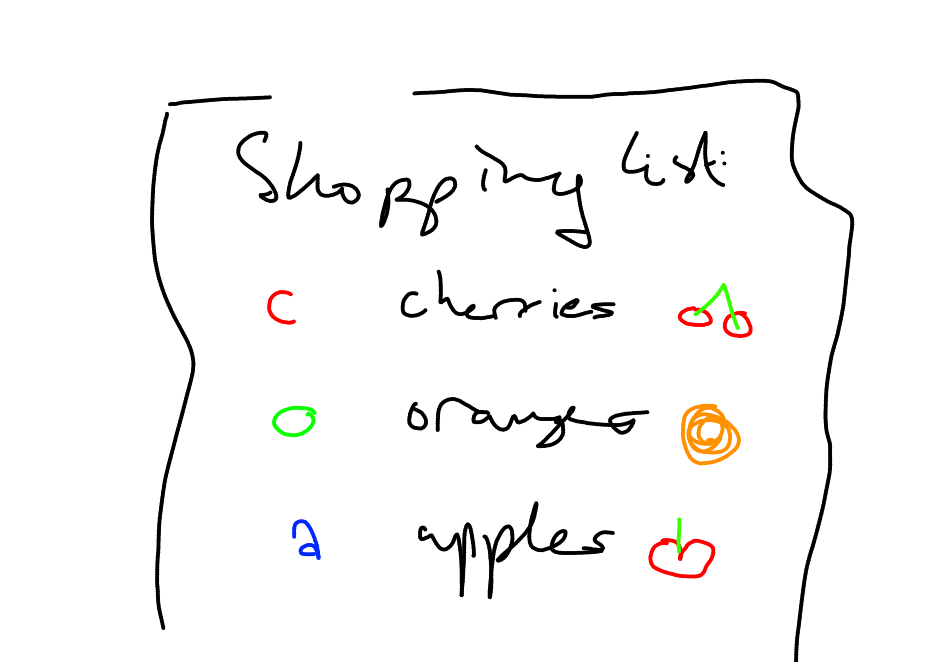
Then, when you get to the fruit vendor, the price has suddenly changed! (read these as variables)
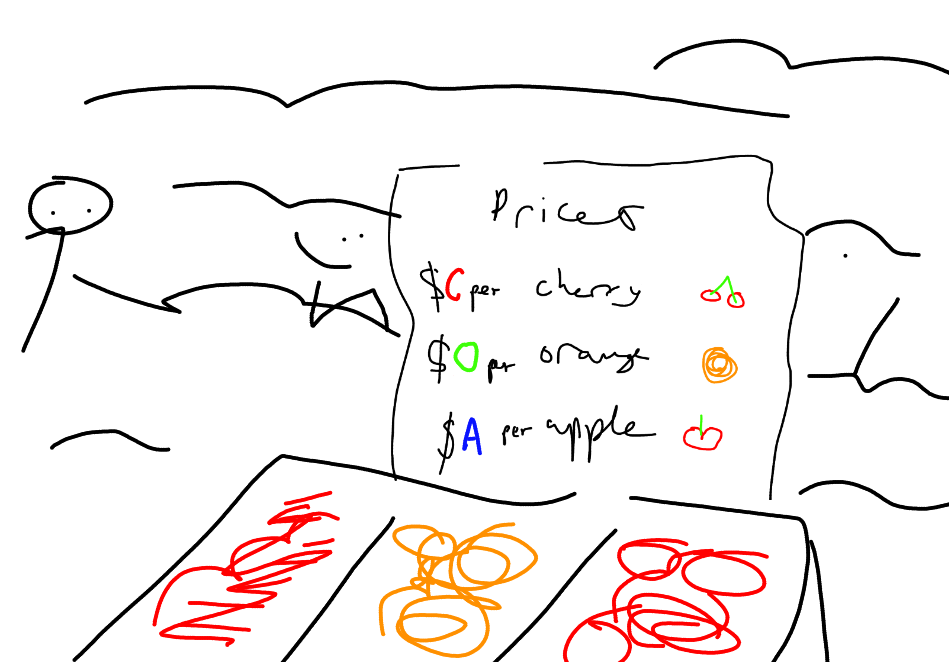
NOW how much does all of your fruit cost?
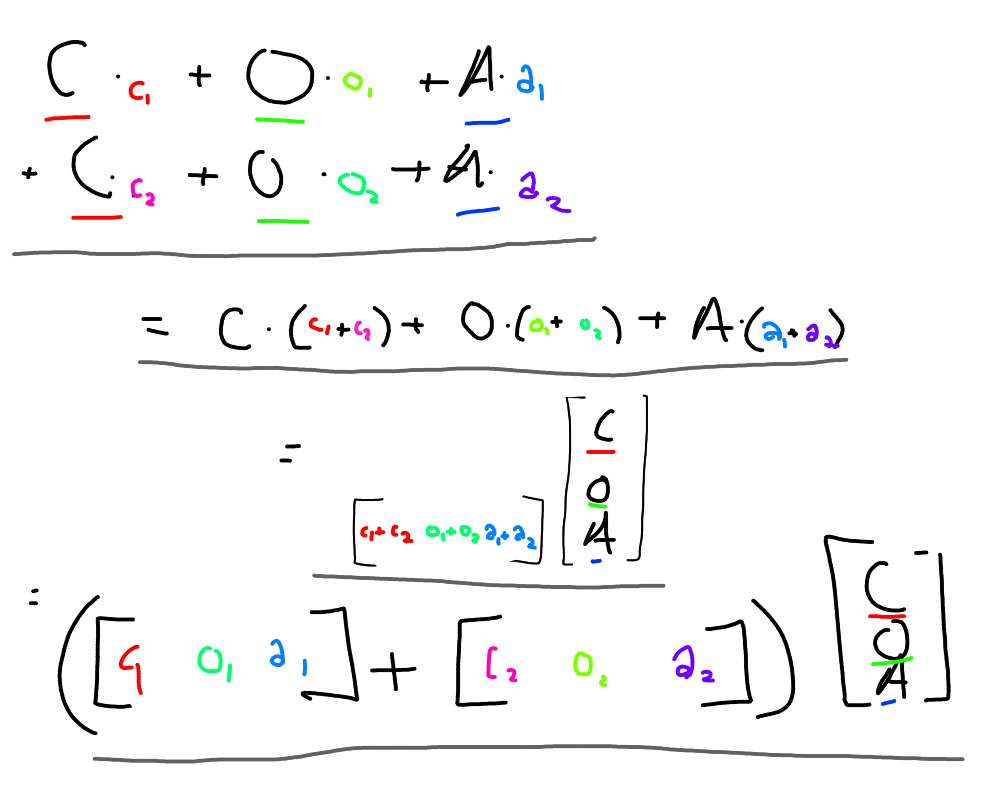
well, it's:
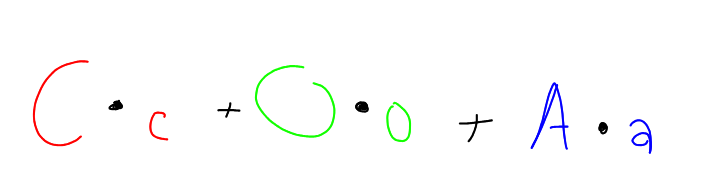
Instead of writing it all out like this, there’s actually an easier way to smush alllll of this up:
Matrices! They’re like a shorthand for this typa stuff.
You put your list on the left and the prices on the right, and you get the total price:
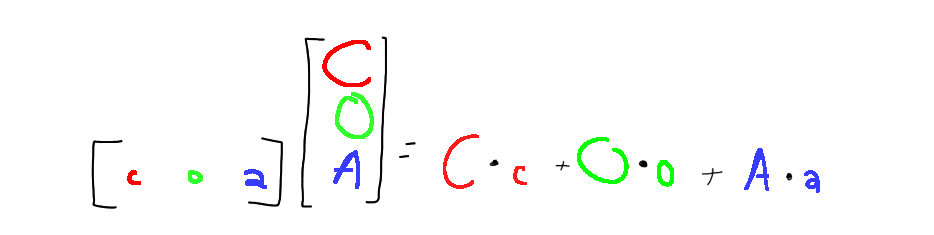
This^ on the left is called a 1x3 matrix and this^ on the right is a 3x1 matrix. dimensions go vertical by horizontal.
Combining matrices like this is called matrix multiplication, and it goes left to right, top to bottom:
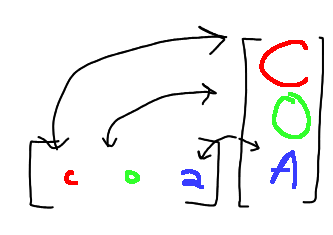
don't worry too much about the specifics of matrices right now, just know what it represents. :>
Notice some things!
When you buy one cherry and one orange separately the price is
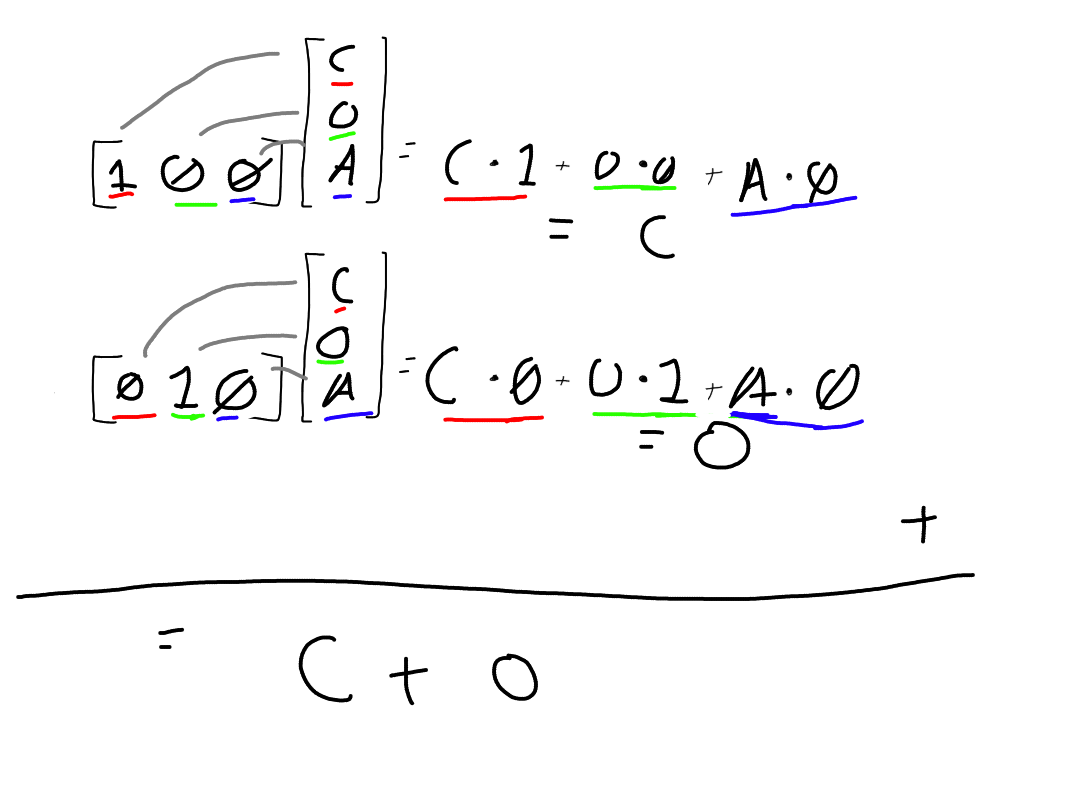
, which is the same as if you’d bought a cherry and orange together!
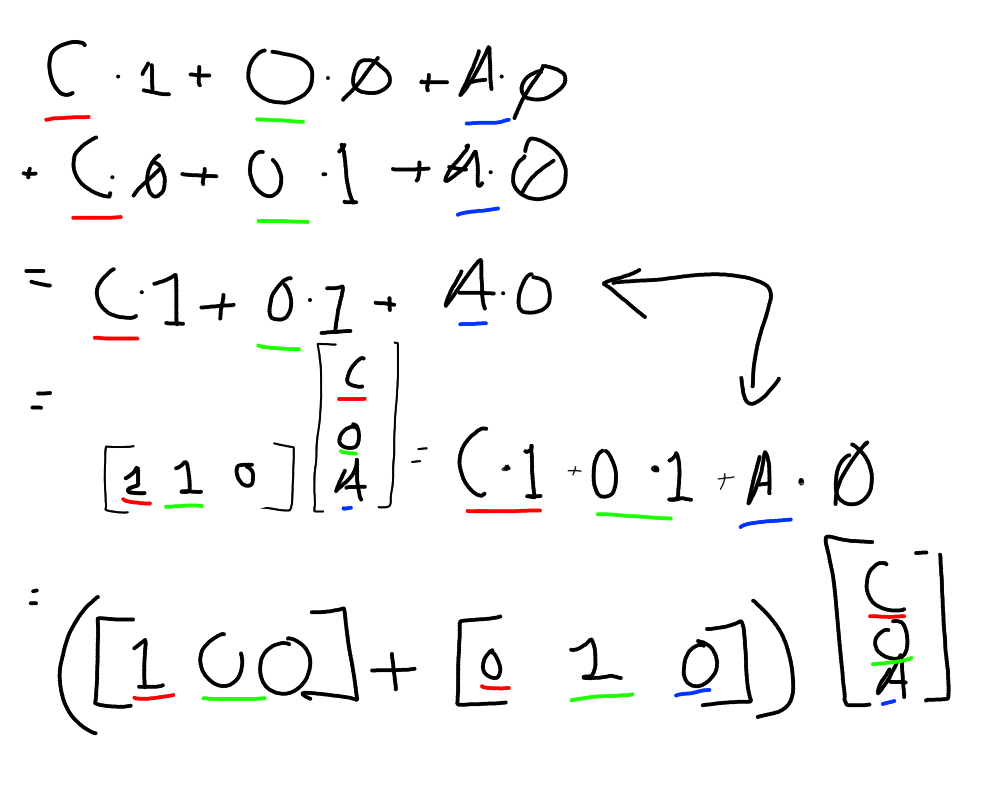
In general buying things separately and adding the cost is the same as buying them together in our scenario. Distributive property!!!
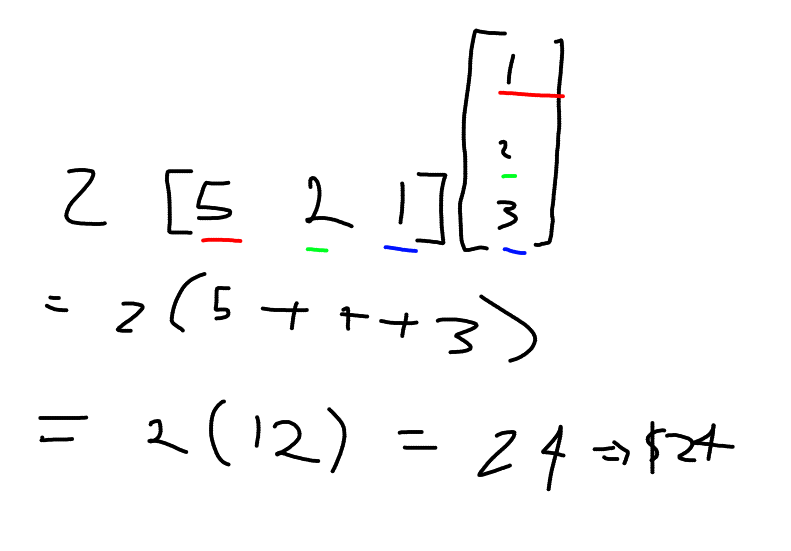
This means if you buy two of everything, which is the same as buying everything twice, the final price is j the original *2.
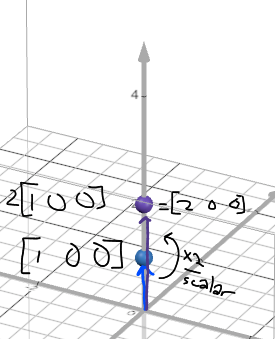
Or, if prices suddenly double, then the final price is the original *2. In general, multiplying any of these matrices by a single number (called a scalar) multiplies (scales) the final price by that number.
The grocery list and the prices though? Those aren’t scalars, but rather, things we call *vectors*, because you can scale them and add them (in ways that abide by the vector rules). Scalars scale vectors, but vectors don't scale other vectors. Vectors are the things that are scaled and added.
In general, when you can scale and add things (in ways that work like scaling and adding), we call them *vectors*. We can visualize a vector with arrows pointing to coordinates (desmos!):
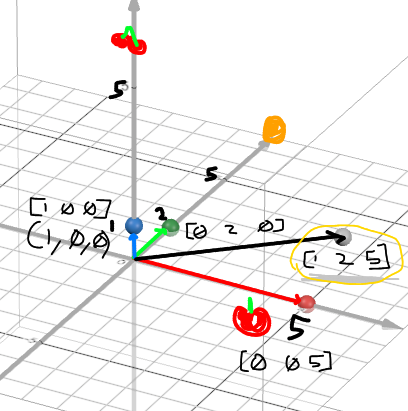
We can also say that the prices are a *covector* for the grocery list (vectors but co-), bc it takes a *vector* and returns us a single number, and it does that linearly (it's like multiplication). Lemme show you line.
If you keep everything else the same, and just change the number of cherries you buy, and look at the final price, and then graph it, you get a straight line, because $ = C*c + (constant). here, that's $ = 1*c + 7
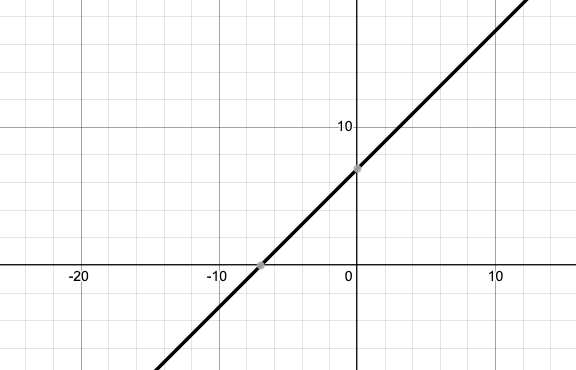
Line! Hence, linear. If you graph everything depending on two things, you get a plane, which is basically a 2d line. In our case that's $ = 1*c + 2*o + 3. i've also plotted the case when we're buying 5 cherries and 2 oranges (and one apple implied). Note that these 3 dimensions are cherries, oranges, and $ (going up is $), while the vectors had dimensions cherries, oranges, and apples.
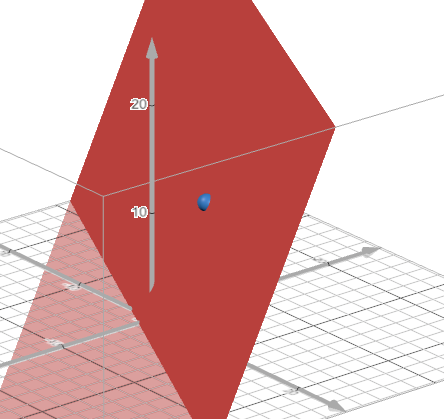
Everything depending on three things is hard to visualize, but we call it a hyperplane. It exists in 4d bc there are 4 things we’re plotting: c, o, a, and $. no visualization for this one, sorry :P
Also!
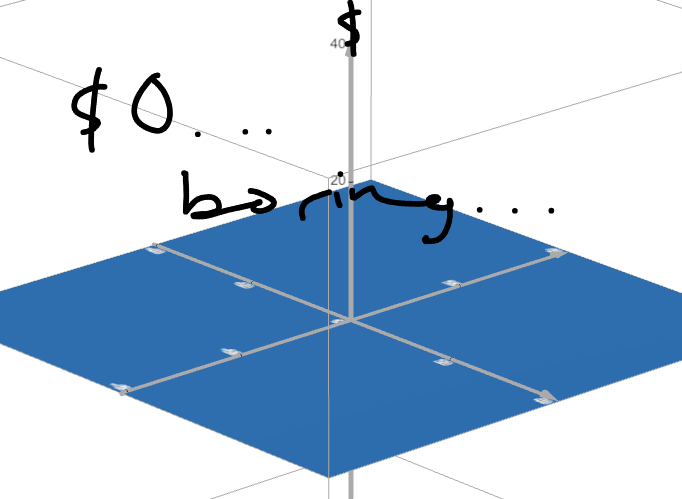
If you buy absolutely nothing, the price turns out to be $0. The hyperplane goes through the point (0,0,0,0), meaning 0 cherries, 0 oranges, 0 apples, and $0. If everything were free, the line would be flat, the plane, also flat, and the hyperplane would also j go through any (x, y, z, 0). Everything would be $0 because everything’s free and anything * 0 = 0. This also agrees with our scaling rules.
Yay!
now one last thing about co- and contra-.
our price list is a covector and is covariant to changes in bases, while our shopping list is j a regular ol' contravariant vector. what does this mean?
well, say instead of buying j each fruit by the piece, we bought fruit by the pair. (not pear the fruit :P)
also assume for these purposes you can buy a real number of fruit, that means like any number, not j integers or whole numbers :P
anyoo let's update our shopping list:
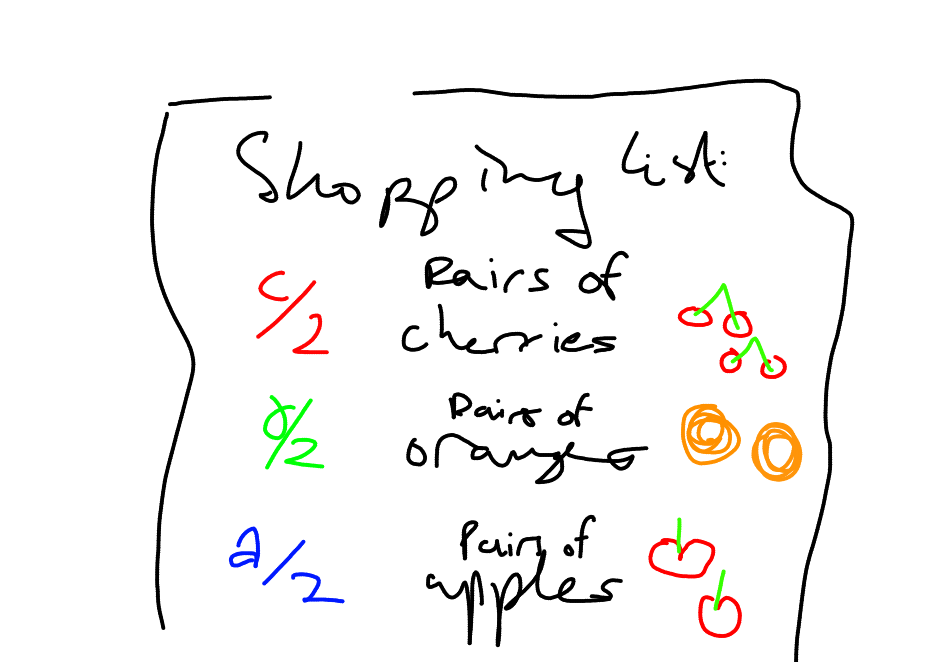
ofc, all of the numbers should be divided by two. but why?
let's look at the units:
Each pair is two fruits. That means 1 pair of fruit = 2 fruit. Hence, fruit = 1/2 pair of fruit.
![[c o a] fruit = [c o a] pairs/2 = [c/2 o/2 a/2] pairs](https://jan-pi-kili-mun.neocities.org/SOME/19.png)
but what about the prices? naturally, the prices have to *double* because you're buying two fruit for each pair. Let's write out the units:
![vertical [C O A] $/fruit = vertical [C O A] $/(pairs/2) = vertical [C*2 O*2 A*2] $/pairs](https://jan-pi-kili-mun.neocities.org/SOME/20.png)
so when our units (each fruit and each pair of fruit) doubled, we had to do the *opposite* to make our shopping list represent the same thing.
But! we did the *same* thing to the price list!
Our regular contravariant vectors transform *against aka contra-* the change in units, while the covariant covectors transform *with aka co-* the change in units!
another example:
the person selling you fruit has started selling fruit in boxes! Each box has a certain number of fruit, with the pricing for each fruit staying the same. capitalism amirite?
there are still *three options*, but each option is now different:
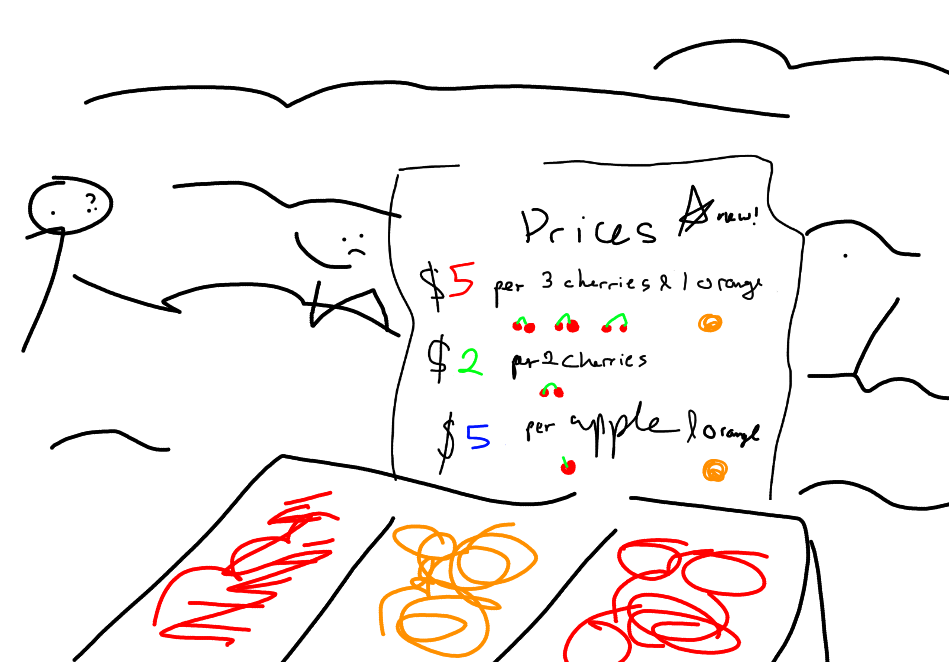
but your shopping list didn't change. let's represent it now with our new options:
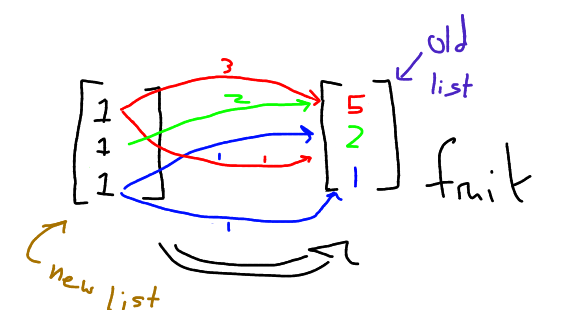
notice how the numbers are smaller. we essentially had to *undo* the combination.
meanwhile, the covariant vectors do the same thing as the combination:
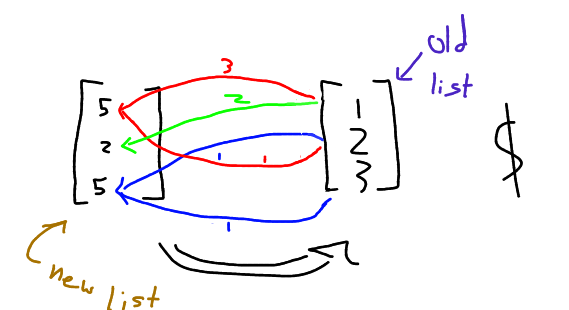
The contravariant vectors transform *away* from our, well, it's called a *change of basis* (you can represent buying any number of fruit either using the simple shopping list or this more complicated one, given you can buy a real number of each thing).
The covariant vectors, on the other hand, transform *with* our change of basis.
oki yay! :3 now some things to think about:
sometimes you can buy all you need with three options. sometimes, however, you can't. take, for example, if you could buy 1 orange, 2 oranges, or 1 apple. How are you going to get your cherries now?!?!
how do you tell if you can buy everything or not? In other words, how do you tell if it's a change of basis?
remember when I told you not to think too much about multiplying matrices? now is the time to do so :3 can you think of a way to represent our change of basis, or any 3 choices of combinations of fruits, through a matrix? it doesn't necessarily have to be 1x3 or 3x1— matrices can come in dimensions like, oh idk, like, 3x3, as well >:)